
RATALANDIA
Rediscover the stories of power and corruption that condemned an entire nation in this essay by author David Salazar. With a raw and provocative analysis of the Peruvian political situation, Salazar exposes the uncomfortable truths behind political leaders and the media.
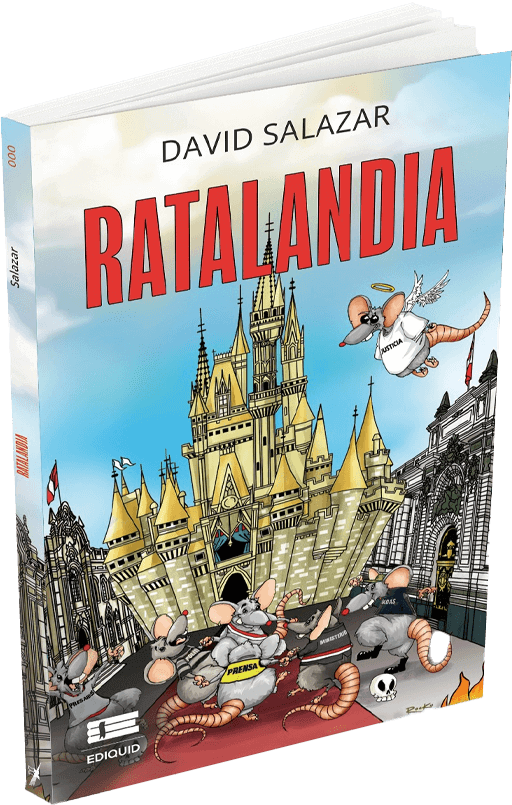
A Raw and Insightful Perspective
of Peruvian Politics and the Press.
Since the pandemic lockdown, the author has gathered and analyzed information, including hundreds of videos and articles, to provide a comprehensive view of the mediocrity and lack of morality of our leaders and the media..
A comprehensive journey through the most impactful episodes of corruption in Peruvian politics, highlighting the most prominent figures and their most despicable actions.
With incisive and well-informed critique, it explores not only the mediocrity and lack of morals among political leaders but also the questionable role of the press. Often presented as guardians of truth, they succumb to corruption and manipulation themselves.
Through a sharp and biting narrative, the author reveals the intricate web of power and ambition that has perpetuated a cycle of oppression and disdain for popular will, offering a profound reflection on the need for change with transparency and ethics.
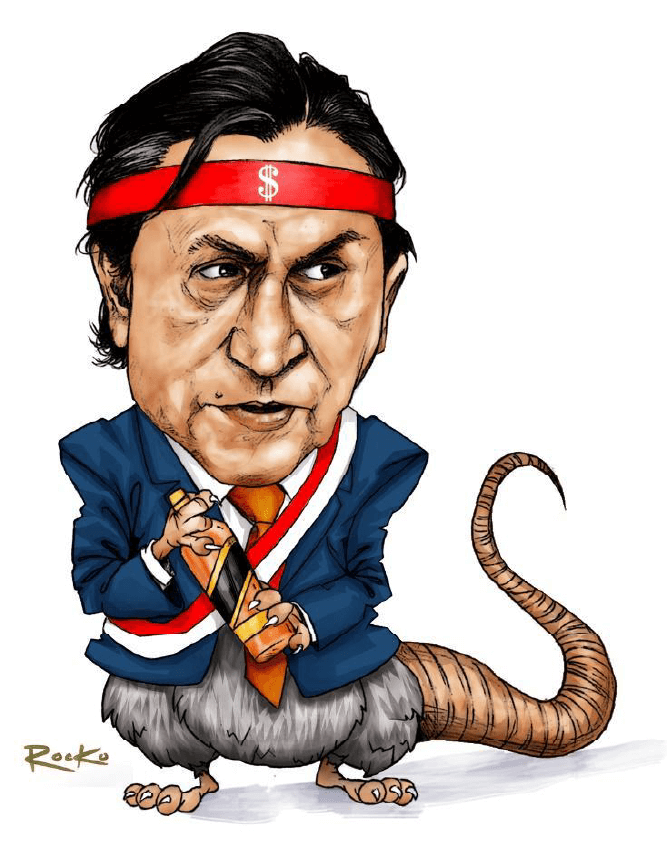
As a prologue
The author has kindly asked me to write a few paragraphs to serve as a prologue to his work "Ratalandia," a request to which I have agreed due to the importance of the topic it addresses and because he approaches it with adequate firsthand knowledge. This has enabled him to draw conclusions, judgments, and recommendations that are justified by a deep understanding of Peruvian society, which he specifically focuses on.
Under the aforementioned title, the author addresses the issue of corruption, a malignant activity that, according to him, has been plaguing the population of the Republic of Peru during the period covered. It begins in 1985 with the election of Alan García as president of the Republic and culminates with the election of Pedro Castillo in 2021 to occupy this high public office.
It is a social scourge that has spread across most countries in the world, with very few exceptions, manifesting and developing through various forms and aspects. The painful consequence is that the poorest and most vulnerable social classes suffer from it. They become victims and endure all the abuses, pillaging, and excesses committed by those who hold political and economic power.
The author exposes the scandalous and painful reality that Peruvian society has been enduring, addressing the issue in a straightforward, realistic, and caustic manner. This is done with the clear purpose of making readers aware that corruption is a grave political, social, and cultural problem, leading to the looting of state coffers, the illicit enrichment of rulers and their associates, and the endless impoverishment of the most humble social classes. In summary, it is a monumental social injustice with no chance for the perpetrators to be held accountable for their actions.
The following paragraphs from the book eloquently summarize what has happened in the Republic of Peru over the past decades:
Since I became aware of the role of politics in a country's development, over the period spanning 35 years from 1985 to 2020, I can assert, supported by empirical evidence, that the economy, represented by the GDP, has experienced sustained growth and has multiplied by more than ten times. This constitutes a significant improvement compared to many countries in the region and around the world.
Our economic indicators have shown notable improvements, especially over the past two decades. However, in terms of the quality of life for the majority of the population and political stability, we have witnessed a constant deterioration.
Most concerning is that we have fallen into a vicious circle from which it is almost impossible to escape. Corruption is advancing at an even faster pace, destroying everything in its path like a great soul-devouring machine.
This conclusion is perfectly applicable to what is currently happening in the vast majority of countries around the world, with a deep focus on Latin America, our geographic area. Simply perusing the book inappropriately titled "The Panama Papers," the product of a journalistic investigation initiated by German professionals and subsequently involving a large number of journalists from other countries, reveals that a substantial group of German banks were laundering vast amounts of money. This money belonged to presidents, heads of government, state ministers, sheikhs, large industrial companies, and other individuals with significant political and economic power, who were transferring these dubious funds to banks in countries considered "tax havens."
In our Americas, there are countries with abundant economic resources, including precious and non-precious minerals, oil, agricultural and livestock products, plentiful natural and artificial resources crucial for the tourism industry, and many others. However, in these countries, the percentage of the population living in poverty and extreme poverty is alarmingly high. It is said that 20% of the population owns 80% of the resources, while the remaining 80% of the population only has access to 20% of these resources.
This ominous reality was one of the reasons that led the distinguished writer and journalist, Nobel Prize in Literature laureate Gabriel García Márquez, to declare in 1983 during his keynote speech upon receiving said prize: "The solitude of Latin America doesn't stem from the immense distances that separate us from the great cultural centers of Europe, but from the colossal and contradictory lives of its inhabitants."
And on that occasion, he pointed out that within this painful reality experienced by our Latin America is the fact that every year, due to causes and diseases associated with poverty, more children die before reaching the age of 5 than all those born in Europe during the same period.
This monumental injustice should shame all leaders and others who, through action or inaction, have contributed to perpetuating it.
It is pertinent to point out that great classics produced by human talent attain that status because their authors highlight a theme of universal and timeless interest. Their significance survives the passage of time and is applicable to any country in the world.
To illustrate this point, it is also fitting to cite what the distinguished French writer Victor Hugo wrote in his masterpiece "Les Misérables," regarding the injustice of judging an innocent mentally disabled man in a French court. On that occasion, he famously expressed:
To think that in this courtroom, where it was assumed there were so many people well-versed in law, only one person knew the truth: the mentally disabled man who knew he was innocent.
And to think that in these places, the pinnacle of humanity's work, the law, is applied alongside the work of God, which is justice.
What García Márquez and Victor Hugo said is perfectly applicable today and anywhere in the known world because the political and social reality of our countries remains the same, albeit with different nuances.
In the opinion of the writer of these paragraphs, anyone who opposes corruption and contributes their bit to fight against this social evil demonstrates that they are a person whose life is guided by genuine ethical values and makes a valuable contribution to society. Therefore, I declare that this literary work and its author are objects of my admiration.
Dr. Olmedo Sanjur G.
https://rosaslaw.com/olmedo-sanjur/
Panama, April 20, 2023
ABOUT THE BOOK
Ratalandia» expone sin contemplaciones la corrupción y la hipocresía en la política peruana, desafiando al lector a cuestionar el sistema.
With a critical gaze and biting language, it reveals abuses of power and lack of transparency, raising awareness about the urgent need for change in society.
Other purchase options
About the Author
Engineer and leader with a passion for justice and equity, David Salazar seeks to promote positive change through his writings. His commitment to integrity and transparency defines him both as an author and a responsible citizen.
En «Ratalandia», David Salazar expone con precisión y valentía la corrupción política y mediática en Perú. Su prosa incisiva y su análisis ponderado invitan al lector a cuestionar y actuar contra la injusticia social.



The Reader's Opinion
Whoever opposes the scourge of corruption and works to expose it demonstrates a deep commitment to ethical values and social justice. The meticulous chronology of corruption acts in Peru and the progressive deterioration of its institutions not only sheds light on the recent political history of this country but also reflects what is happening in many Latin American countries today. This work inspires us to come together and fight for a more just society, where we can elect leaders with unwavering honesty. I feel honored to comment on this work, and of course, it deserves a standing ovation for the author.
Ratalandia is a stark and realistic criticism of corruption in Peru. David Salazar bravely and precisely exposes the injustices that have devastated our country, inviting us to reflect and act for a better future. A work that will not leave anyone indifferent.
In the opinion of the writer of this paragraph, anyone who opposes corruption and contributes to the fight against this social evil demonstrates living by genuine ethical values and makes a valuable contribution to society. Therefore, I declare that this literary work and its author are objects of my admiration.
With colloquial and casual language, the author of Ratalandia puts his finger on that open wound due to corruption in Peru, and points out the role of politicians, journalists and the media in front of it.
When a nation is capable of choosing its leaders wisely, it saves itself from a life of misery and pain. It's a shame that in Latin America, a history marked by corruption and power struggles repeats itself. It's a tale of lies and abuses against the most vulnerable.
Peru has not escaped this harsh reality, with a political history marked by deceit, violence, and social decay. This work courageously and meticulously references each of the governments whose dark pasts have shaped the present that the nation endures today, suffering severe economic, social, and emotional consequences from years of false promises.
Special recognition to the author for portraying the panorama of Peru with sharpness and determination.
FOLLOW ME ON SOCIAL MEDIA

Mi recorrido por la vida y mi experiencia laboral me han demostrado la importancia de la integridad en todos los ámbitos. Con «Ratalandia», espero inspirar una profunda reflexión sobre los valores que realmente importan en nuestra sociedad.
– David Salazar